
06 January 2025. Nigel for Prospect.
Demands by Caribbean nations for compensation ignore historical reality and the achievements of British abolitionism.
White British involvement in Atlantic slave-trading and slavery for over a century-and-a-half up to the early 1800s amounted to “the Black Holocaust, the British genocide”, according to Sir Hilary Beckles, historian, vice-chancellor of the University of the West Indies, and chairman of the Caricom Reparations Commission, which seeks to “establish the moral, ethical and legal case for the payment of reparations by the governments of all the former colonial powers” in the Caribbean region. Chattel slavery on the sugar plantations of the West Indies was a unique atrocity that made a major contribution to the economic industrialisation of Britain and thereby to British prosperity today. The abolition of slavery in 1833 compensated the slave-owners but not the slaves. The Caribbean descendants of slaves now suffer intergenerational trauma, resulting in poor social and economic outcomes. Britain, therefore, owes reparations.
That conclusion would follow, if the preceding statements were true. But they aren’t.
First, slave-trading was by no means a peculiarly white European enterprise. Black Africans had been busy enslaving other Africans and selling them to the Romans and then to the Arabs long before Europeans arrived on the scene. One estimate has it that Arab raiders from Tunis, Algiers and Tripoli enslaved between one million and 1.25m Europeans from the beginning of the 16th century to the middle of the 18th. Another estimate reckons that the Arab slave trade as a whole, which lasted from the seventh century AD until well into the 20th century, transported about 17m slaves, mostly African, considerably exceeding the 11m shipped by Europeans across the Atlantic, albeit over a shorter period from 1526 to 1873.
And contrary to Beckles’s claim that African chiefs opposed the slave trade, the Beninese historian, Abiola Félix Iroko, has said that when the slave trade was abolished by the British, “Africans were against abolition…. Of those who were sold [as slaves] and had offspring… [s]ome returned home… [and] became, in turn, slaveholders and bought slaves for their correspondents who remained in Brazil. Africans resumed this trade after abolition.”
While plantation slavery in the West Indies was among the most cruelly oppressive, the use of slaves on a massive scale for hard labour was neither invented by Europeans in the Caribbean nor confined to it. As Mohammed Bashir Salau has shown, slave plantations were established by Omani Arabs on the coast of East Africa, and by the Fulani in the Sokoto Caliphate in what is now northern Nigeria, in the 19th century. Indeed, the Caliphate became “one of the largest slave societies in modern history”, equalling the United States in the number of its enslaved (four million).
Nonetheless, can it be claimed that British slavery was uniquely brutal? Not obviously. Of the plight of a white European slave owned by an Arab master on the Barbary Coast of North Africa, the historian of Algiers, Henri Delmas de Grammont, wrote in 1885: “as chattel of whomsoever chose to buy him, he would be utterly without rights or a will of his own, his very life forfeit to the whim of his new owner, who could resell him, overload him with work, imprison him, beat him, mutilate him, kill him, without anyone interfering.” The experience of Miguel de Cervantes, the author of Don Quixote who was enslaved in 1575, bears this out. According to a first-hand witness, Cervantes “was on the verge of losing it [his life] on four different occasions when he was nearly impaled or hooked or burned alive…”.
Read the full article at Prospect.
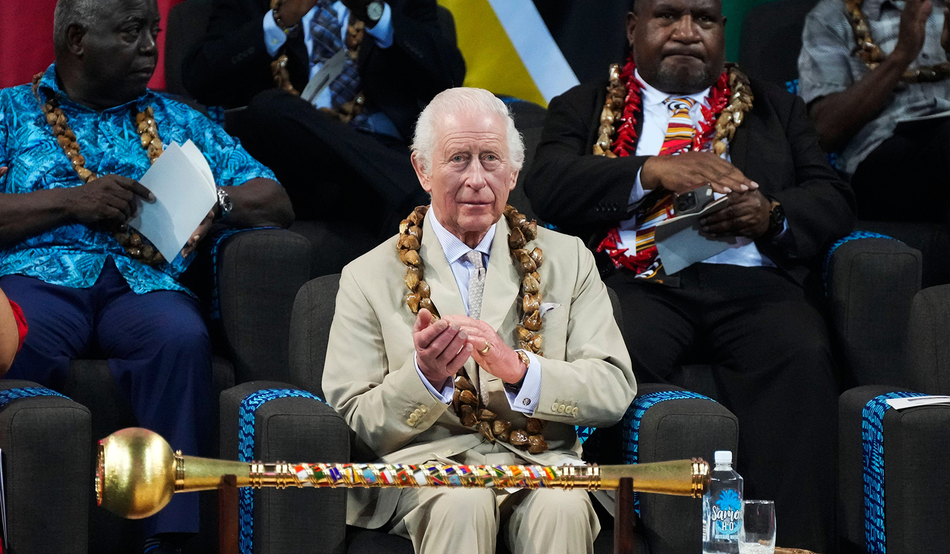
Feature image: King Charles at the Commonwealth Heads of Government meeting in Apia, Samoa, October 2024. Photo by Associated Press / Alamy Stock Photo.